
Sierra Club |
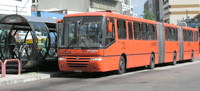 Curitiba, Brazil - showing the world how it’s done Curitiba, Brazil - showing the world how it’s doneBy Robert Bernstein Curitiba, Brazil, is an industrial city of about two million people in southern Brazil, far from the beaches and other tourist attractions. Yet it has become a Mecca for those who are interested in environmental innovation. I had wanted to go for many years; several innovations in particular intrigued me. I went there in February, curious to see if they were real or were just a public relations showcase. Curitiba is a prosperous city by Brazilian standards. It is so prosperous that the number of automobiles was causing serious traffic and pollution problems. Back in the 1970s, Mayor Jaime Lerner was interested in developing a public-transit alternative that would be so efficient that it would coax people out of their cars as well as serve the transit-dependent. Subway systems and even light rail were beyond his budget. Yet he noted three things that made those systems effective in comparison to buses: a separate right-of-way, payment in advance of boarding and multiple doors for boarding and exiting. He invented a bus design that achieved all three of these at a fraction of the cost of rail systems. The result was a "bi-articulated bus" made up of three sections, combined with a dedicated bus-way and special boarding stations. Even while flying into Curitiba, the system is immediately obvious. These bright orange express buses cross the large city on lines clearly visible from the air. Many local buses fill in the local routes between. There are still plenty of cars, but they won’t get you around faster than the buses will. I found that a five- to 10-minute wait usually brought an express bus to the station. The other passengers and I paid an attendant to enter the little station. When the bus arrived, five doors opened at the level of the station and ramps extended quickly. Since we had already paid, there was no fumbling with money or slowly filing on through one narrow door. People quickly exited and in seconds a dozen or more of us could board. The whole system is totally friendly for the disabled. The buses still had to stop at traffic signals, but we were always first in line in our dedicated bus-way. The city has another bus system that allows visitors to tour the city’s major sites of interest, and I used this as well. Several of the sites were the parks I had read about. At first, the parks seemed to be formal gardens. But then I realized these were just the fronts of large preserves. Curitiba had reclaimed degraded and flood-prone land and made it enjoyable for humans and as restored natural ecosystems. It was at one of these parks that I met a couple from New York and one of their Brazilian friends, Priscilla. Priscilla showed us another Curitiba innovation: the Towers of Learning. What looked from a distance like a lighthouse tower was really one of many little public-access computer centers. They provide free Internet access and computer use for anyone who walks in. The librarian kindly invited me to climb the tower for the view while another of our party logged on a computer to e-mail her friends back in New York. The buses, park-preserves and Towers of Learning are real, well-used and appreciated. I was only left with one big question: Why is this model not being duplicated across Brazil and across the world? Robert Bernstein is vice-chair of the Sierra Club Santa Barbara Group.
Caption:
Among Curitiba’s innovations are dedicated busways, special boarding
structures and three-section buses. The buses get travelers around as
quickly as cars do. |